
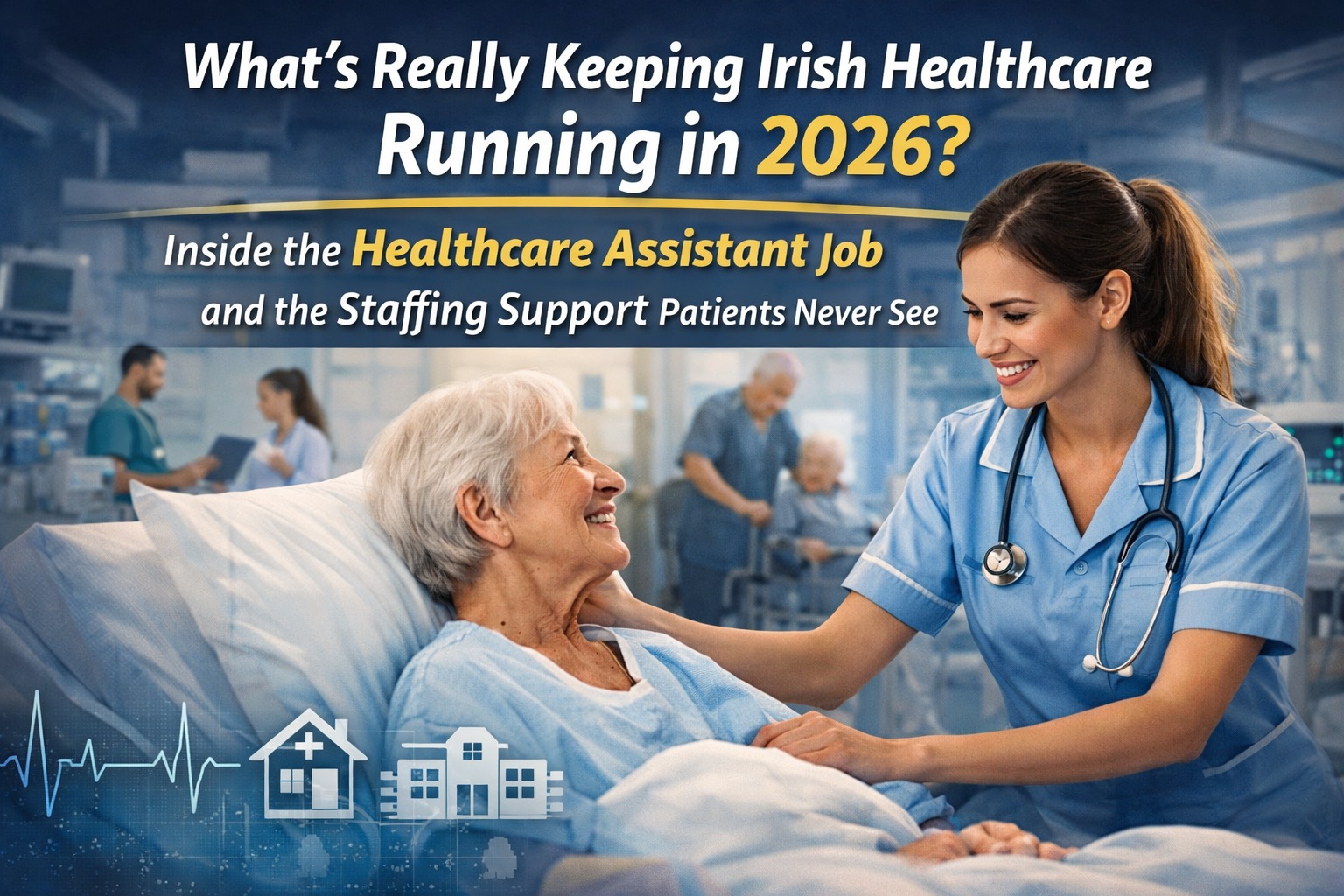
 When people talk about Irish healthcare in 2026, they usually talk about waiting lists, hospital capacity, home support, and care closer to home. What gets far less attention is the role quietly holding so much of that system together: the Healthcare Assistant.
For many patients, the Healthcare Assistant job is the difference between feeling frightened and feeling supported, between being processed and being cared for. And for healthcare providers across Ireland, the ability to access dependable staffing support is often the difference between a service that is stretched and a service that stays safe, responsive, and fully supported.
That matters even more now. The HSE’s National Service Plan 2026 sets out a €29 billion health and social care service budget and prioritises access to care closer to home, including a target of 26.7 million home support hours. Ireland’s six HSE Health Regions are also now central to how services are planned and delivered around local population needs.
So, what does a day in the life of a Healthcare Assistant in Ireland actually look like? And why are staffing agencies becoming such an important part of keeping healthcare services fully supported?
-
A day in the life of a Healthcare Assistant in Ireland
A Healthcare Assistant starts the day long before most people realise how much work happens behind the scenes.
In hospitals, residential care settings, disability services, and home support, the role is practical, hands-on, and deeply personal. HCAs support people with day-to-day care needs, work under the direction of qualified clinicians, and help patients and service users maintain dignity, comfort, and routine. HSE career guidance describes the HCA role as a frontline support position across hospitals, clinics, nursing homes, and community settings, and notes that QQI Level 5 in Healthcare is a standard entry requirement for the role.
A typical day may begin with handover from the previous shift. That means understanding who needs mobility support, who needs extra reassurance, who may be at risk of falls, and who needs assistance with washing, dressing, eating, or moving safely. It also means noticing small changes others might miss: tiredness, confusion, discomfort, loss of appetite, or a change in mood.
That is one of the most underestimated parts of the Healthcare Assistant job. It is not “just helping out.” It is being present enough, observant enough, and skilled enough to recognise when a person needs more support.
As the day moves on, the pace can change quickly. One patient may need emotional reassurance before an appointment. Another may need support getting from bed to chair. In home support, the visit may involve helping an older person remain safe and independent in their own home. In disability services, the work may be more focused on person-centred support, routine, inclusion, and quality of life.
Across Ireland, these are not side roles. HSE Career Hub states that Patient & Client Care roles, which include healthcare assistants, attendants, and therapy assistants, make up 20% of the entire health and social care workforce.
So when someone searches for a job in Ireland that is meaningful, stable, people-focused, and directly connected to better healthcare outcomes, the Healthcare Assistant role stands out for good reason.
-
Why the Healthcare Assistant job matters even more in Ireland in 2026
The Irish healthcare system is changing. But the pressure on services has not gone away.
The current direction of reform is clear: more integrated care, more community-based support, and more care delivered closer to home. The HSE Corporate Plan 2025–2027 prioritises safe care tailored to individual needs, digitalisation, and care closer to home, while Health Regions are designed to align acute and community services around local population need.
That shift creates more opportunity for the Healthcare Assistant job in Ireland, especially in community care, older persons services, disability support, and home support.
It also reflects a deeper long-term reality. In 2025, the Department of Health said the ESRI’s review of older people’s care projected that Ireland would need a substantial increase in capacity by 2040, including at least 57% more home support hours, 61% more long-term residential care beds, and 72% more short-term residential care beds.
That means healthcare providers are not simply hiring for today. They are trying to build resilient teams for a healthcare system under real demographic pressure.
For employers, that raises the importance of workforce planning. For candidates, it shows that the Healthcare Assistant role is increasingly recognised as essential in the wider Ireland job market.
-
How staffing agencies help healthcare services stay fully supported
Here is the reality healthcare managers already know: demand does not arrive neatly.
Services face sick leave, annual leave, last-minute absences, discharge pressure, rising community demand, recruitment gaps, and fluctuating patient needs. A rota may look fine on paper and become difficult within hours.
This is where staffing agencies play a serious operational role in healthcare.
A strong agency does not simply “send staff.” It helps healthcare providers keep services running when permanent teams are under pressure. In practice, that can mean:
- covering short-notice absences
- supporting peak-demand periods
- filling temporary or hard-to-recruit roles
- helping services maintain continuity of care
- supplying pre-screened workers who are ready to step into patient-facing environments
- giving providers access to a wider talent pool across different regions and care settings
That is especially relevant in Ireland now. HSE Performance Committee minutes in late 2025 explicitly noted increasing demand for home support and reliance on the private sector to meet that demand. At the same time, the latest Health Regions update says each region works within approved staffing numbers and must replace and recruit staff in ways that respond effectively to local population need.
In other words, staffing flexibility is no longer a “nice to have.” It is part of how services stay responsive.
For hospitals, nursing homes, community care providers, and home support services, the right staffing agency can reduce disruption, protect patient experience, and help permanent teams avoid burnout.
For candidates, agencies also create access. A Healthcare Assistant looking for a job in Ireland may want full-time work, flexible shifts, regional opportunities, or a route into a long-term healthcare career. Staffing agencies can help match the right person to the right service at the right time.
-
The human side of the Healthcare Assistant role
For all the talk about reform, capacity, and workforce planning, the core of the role stays the same.
A Healthcare Assistant is often the person who notices when someone is anxious. The person who helps preserve dignity in vulnerable moments. The person who makes a hospital ward feel calmer, a residential setting feel more supportive, or a home visit feel more personal.
That human side is exactly why the role matters so much to Irish healthcare.
It is also why healthcare providers cannot afford gaps in support.
When the right people are in place, patients feel it. Teams feel it. Families feel it. And services work better.
-
Final thought
In 2026, the conversation around healthcare in Ireland is rightly focused on access, integration, and care closer to home. But none of that works without people on the ground delivering compassionate, consistent support every single day.
That is the real story behind the Healthcare Assistant job.
And it is also why staffing agencies matter more than ever. They help healthcare services stay fully supported, protect continuity of care, and ensure that when demand rises, providers are not left facing it alone.
For employers trying to strengthen their workforce, and for candidates searching for the right Ireland job in healthcare, the message is simple: the future of care depends on having the right people in the right place when they are needed most.